Vruksharacha's warning
. . . a good piece of gutta percha will insulate as well as an equal piece of shell-lac, whether it be in the form of sheet, or rod, of filament; but being tough and flexible when cold, as well as soft when hot, it will serve better than shell-lac in many cases where the brittleness of the latter is an inconvenience. Thus it makes very good handles for carriers of electricity in experiments on induction, not being liable to fracture: in the form of thin band or string it makes an excellent insulating suspender: a piece of it in sheet makes a most convenient insulating basis for anything placed on it . . .
Michael Faraday (1848) On the use of gutta percha in electrical insulation,
Philosophical Magazine Series 3 32(214), p. 166.
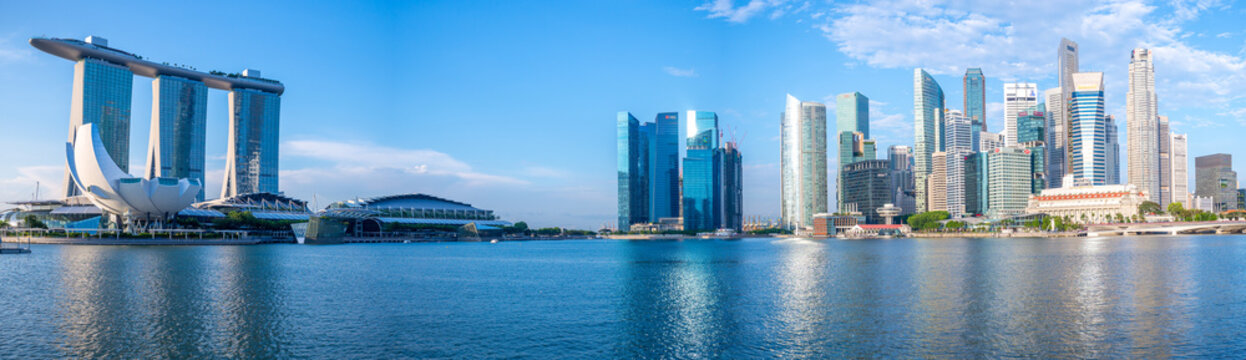
Long before tall buildings touched the clouds and bright lights shimmered along the river, Singapore was a green island filled with birdsong, cicadas, and trees that talked.
If you knew how to listen.
Among them stood a very old tree, a proud Taban malayanus, growing on a quiet hill near the jungle’s edge. His bark was grey-brown and scaly, and inside him flowed a milk that humans called getah percha ݢته ڤرچ1, though the trees simply called it exudatum vulnerarium or wound-sealing resin.
This old tree’s name was Vruksharacha.
Vruksharacha had lived through many monsoon seasons. He had watched boats come and go, heard new languages drift through the forest, and learned that humans often spoke loudly but listened very little.
One afternoon, while cicadas hummed their sleepy songs, Vruksharacha overheard something that made his leaves tremble.
Two men stood nearby, shaded by younger trees. One spoke with a careful, Scottish accent. His name was William Wemyss Ker. The other wore fine clothes and carried authority in his voice.
Vruksharacha listened quietly, as trees do.

“If we scale up the felling,”
the Victorian gentleman said,
“we can obtain far more. The demand in London is growing quickly.”
The Malay prince nodded.
“Then we must act before others do.”
The words scale up echoed inside Vruksharacha’s trunk like distant thunder.
As the two men walked away, their footsteps fading into the jungle, Vruksharacha stood very still. For a moment, the forest felt much older than the words he had just heard. Vruksharacha remembered something else.

He remembered a quieter time, about 30 years long ago2, when the sea had reached closer to the trees. He remembered boats gliding gently toward the shore from Bulang, carrying about 150 Orang Laut, their paddles dipping softly into the water.
Among them was a small baby, wrapped in cloth and held carefully in his father’s arms.
“That was him,” Vruksharacha thought softly. “The Temenggong, when he was just a child.”
Vruksharacha remembered how the baby’s father had paused beneath his shade. He remembered how the baby laughed when a leaf drifted down and brushed his tiny hand.
“You grew up here,” Vruksharacha whispered sadly, his leaves rustling. “You grew up with us.”
The old tree felt a deep ache inside his trunk.
“How strange,” he thought,
“that someone who once rested beneath our branches could now speak of cutting us down.”
Trees understood what scale up meant.
That night, when the moon climbed slowly into the sky, Vruksharacha called out in the secret language of roots and rustling leaves.
“Wake up,” he whispered into the soil. “Wake up, brothers and sisters.”
One by one, the other Taban trees stirred. Old trees, young trees, tall ones and short ones—all connected by the underground mycorrhizal network, all listening.
“There is danger,” Vruksharacha said.
“Humans are coming. Not just a few. Many. They will cut us down to drink our milk, and they will not stop.”
Some trees rustled uncertainly.
“Humans have always taken a little,” one said. “We grow back.”
Vruksharacha shook his branches gently.
“This time is different. They want more. Faster. There will not be time to heal.”
He taught the young trees how to hide their milk deep inside. He told the older trees to scatter their seeds toward hills, swamps, and quiet places where humans rarely walked.
“Grow patiently,” he said. “Grow quietly. Remember who you are.”
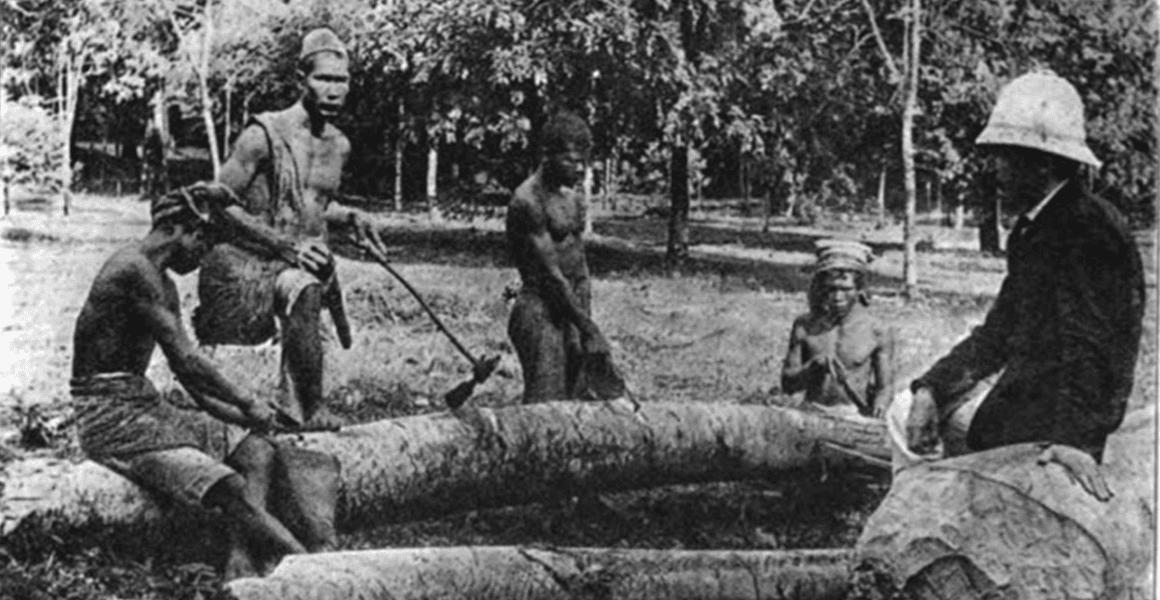
In time, nearly every Taban tree fell, just as Vruksharacha had feared. Their stumps wept pale sap into the Bhumi, mourning what was lost. Yet a few endured—hidden, scattered—bearing the forest’s memory into the future.
Vruksharacha himself grew weaker with time. One morning, as the sun rose pink and gold, he felt the forest breathing around him.
“Even if I fall,” he whispered into the Bhumi, “remember this: trees are not just wood. We are stories.”
And so the Taban trees remembered.
Even today, if you walk through the last quiet green corners of Singapore and rest your hand on a tree, you might feel something warm beneath the bark.
That is Vruksharacha’s voice, still whispering:
“Listen. Protect. Grow gently.”
And with that thought, the forest settles into sleep—and so should you.
- Getah or natural rubber, \(({\rm C_5 H_8})_n\), was initially known as caout-chouc or kawchu (Quechua's word for latex) and the term was entered into the English lexicon in 1776 by a Dutch biologist named Jan Ingenhousz:
. . . and at the other, in a neck adapted to enter the mouth of an elastic gum bottle, otherwise called boradchio or caout-chouc, to be tied to it with a strong ribbon . . .
The technical name of kawchu is cis-1,4-polyisoprene and its repeating unit is 2-methyl-1,3-butadiene (or simply isoprene).

Kawchu has a less elastic cousin in the Malay Archipelago, known to the natives as getah taban. The polymeric milk of the taban tree is stereochemically the trans-version of kawchu, i.e. trans-1,4-polyisoprene. The latex of the taban tree readily coagulates and hardens, and is then rolled into semifinished sheets or pieces, giving rise to the name getah percha (getah pieces, percha ڤرچ is a reference to a rag or a piece of cloth), the name was unfortunately corrupted by the British to gutta-percha.
Getah percha, in its natural occuring form, is more useful than kawchu, as evidenced by the first demonstration (by John Scott Russell) in a Royal Society of Arts meeting on March 19, 1845. Approximately 40 days earlier before Russell's demonstration, the monopoly of the products had already been locked by Charles Hancock and Henry Bewley when they cofounded the Gutta Percha Company, a name which they were able to maintain until 1864, when it was acquired and became a part of Telegraph Construction and Maintenance Co (Telcon), the contractor for the 1865/1866 Atlantic cables.

Pure and unvulcanized kawchu is temperature-sensitive, it is sticky in summer but hardened in winter. Unlike kawchu, getah-percha is readily usable as it is relatively stable and rigid in both summer and winter. In hot water, the stiff \(\beta\)-form of getah-percha can be readily transformed to the softer \(\alpha\)-form, at around 39 to 49 celsius degrees.

Alerted by a British acquaintance—probably William Wemyss Ker (1801–1874)—to the commercial value of getah percha, Temenggong Ibrahim rapidly enriched himself by moving to monopolize the getah-percha export trade. The resulting surge in demand proved catastrophic for Singapore’s taban trees. Within barely two years of William Montgomerie’s getah-percha samples reaching London in 1843, virtually all of the island’s mature taban (estimated to be nearly 70,000) had been killed for their milk. Read (1901) suggested that the Temenggong’s ambition to extend his authority onto the mainland was driven in part by a desire to control the trees in Johore—a goal he ultimately secured with the signing of the 1855 treaty with Sultan Ali.

Mem and selnel, enframed by getah-percha. The proto-Malay word for single and married/couple are bujang and kelamin, respectively, e.g. mai de bujang vs. mai de ya bekelamin. In Malay, kelamin has a slightly extended, albeit narrower, meaning, particularly in alat kelamin, which refers to the apparatus for sexual coupling. Although the proto-Malay do have a word for genitalia, i.e. selnel, the word is not incorporated into the Malay corpus. Following Dentan (1968), emphasis is placed on the distinction between sexual and non-sexual body parts. Both men and women appreciate well-rounded breasts, referring to it (and any spherical artifact) as mem. However, this interest is associated strictly with nourishment rather than sexuality, and mem are not considered part of the selnel or kemaluan. The strictly nutritional role of mem is evident in the fact that they are sometimes seen breastfeeding their pet animals. Like their pre-Victorian Indic counterparts and Khmer women documented by Zhou Daguan (circa 1297), women typically wear garments to cover their selnel but leave their mem exposed, except in the presence of Malays (p. 17), when they choose to cover them, probably of out inter-cultural politeness. Like any culture, sexual modesty is focused on concealing the selnel. For instance, when bathing, they keep their hands over their selnel until they are fully submerged (p. 63). See R. K. Dentan (1968) The Semai: a Nonviolent People of Malaya, Holt, Rinehart, and Winston, New York. See also M. Yalom (1997) A history of the breast, Alfred A. Knopf, New York.
See J. Ingenhousz (1776) Easy methods of measuring the diminution of bulk, taking place upon the mixture of common air and nitrous air; together with experiments on platina. Philosophical Transactions of the Royal Society of London 66(1), p. 258. See also, M. Faraday (1848) On the use of gutta percha in electrical insulation. Philosophical Magazine, Series 3, 32, 165-167. See also the Society of Arts (1845) Athenæum (910), April 5, 1845, p. 337: . . . March 19 . . . the Secretary described the substance called ‘gutta percha’. It is the juice of a large indigeneous forest tree in Singapore; and is obtained by cutting notches through the bark, when it exudes in the form a milky juice which soon curdles. In its chemical properties it somewhat resembles Caoutchouc, but is much less elastic; it however possesses qualities, which that substance does not, which will render it of considerable value as a substitute for medical instruments in hot climates. The Gutta Percha, when dipped in water nearly at the boiling point, can readily be united, and becomes quite plastic, so as to be formed (before it cools below 130 degrees to 140 degrees Fahrenheit), into any required shape, and which it retains at any temperature below 110 degrees; in this state it is very rigid and tough, and it used in Singapore for chopper handles, etc, in preference to buffalo horn, and does not appear to undergo any change in the hot damp climate of the Straits of Malacca. The secretary produced casts from mdeals, a rough lathe band, a short pipe, etc, which he had formed for the occasion, a soda-water bottle containing the juice as collected from the tree had been entirely inclosed by a covering of the Gutta Percha, which was as tough as leather, but by immersion in hot water for two or three minutes was removed, and formed again into a solid lump . . .
See also R. Prakash, V. Gopikrishna, D. Kandaswamy (2005) Gutta-percha - An untold story, Endodontology 17(2), pp. 32 - 36. Probably under the influence of Crawfurd (1852), the etymological explanation given by Prakash et al. (2005) is incorrect since they pair percha with Pertja and claim that Pertja is the Malay name of the tree which produces the latex. The spelling ‘pertja' is based on the Van Ophuijsen system and it is equivalent to percha. J. Crawfurd (1852) A grammar and dictionary of the Malay language, Smith, Elder, and Co., London, p. 50: Gâtah-pârcha. The inspissated juice of the pârcha tree, Isonandra gutta of Sir William Hooker; the guttah-percha of commerce. Gâtah-tâban. Name of a tree yielding a gutta-percha, and, like the last, of the family of the Sapotaceae.

- On January 15, Mahmud III (r. 1761 - 1811) died suddenly. Tengku Husain was bypassed and his half-brother Abd al-Rahman (d. 1832) was installed by Raja Ja‘far (d. 1864), who had just returned to Lingga from Selangor a few years ago.
The event prompted the grandfather of Sultan Abu Bakar, Temenggong Abd al-Rahman, to move from Bulang to Singapore. This migration of a band of about a hundred Malays was prompted by shifts and uncertainties in political landscape in Riau after the death of Sultan Mahmud III in January. 1811 is a critical year in Malay history because it marks the beginning of the end of an old empire.
About 8 years later, when Raffles came to Singapore, he asked Che Salleh who was the raja and Che Salleh took him that evening to Temenggong Abd al-Rahman. Raffles wanted to enthrone him but the Temenggong sent Che Engku Yahya to Che Abu Puteh to invite Tengku Husain to come to Singapore to fish. Raffles installed Husain as Sultan. Temenggong Abd al-Rahman wrote to Bendahari Ali in Pahang, who replied that he would continue his allegiance to Daik and not recognise Singapore (see R. O. Winstedt (1933) Abdul-Jalil, Sultan of Johore (1699 - 1719), Abdul-Jamal, Tememggong (ca. 1750) and Raffles's Founding of Singapore, Journal of the Malayan Branch of the Royal Asiatic Society 2(117), p. 165).

The seal of Sultan Abd al-Rahman of Lingga (see A. T. Gallop 2019, Seal #910, p. 316). The seal reads: al-Wathiq bi-Rabb al-arsh al-Wadud al-Sultan Abd al-Rahman bin al-Sultan Mahmud | Sanah 1225 min Hijrah al-Nabi salla Allah 'alayhi wa-salam seribu dua ratus dua puluh lima tahun yawm al-Jumaat. We have reasons to believe that Abd al-Rahman was installed very hastily by Raja Ja‘far after Mahmud III died in 15 January 1811. This can be inferred directly from the data marked in his seal since Jumaat 1225 in the seal can only mean 18 or 25 January 1811.
The story of Singapore and Raffles could be very different if the 1811 migration did not take place. Incidentally Sultan Abu Bakar's father, was born in Bulang, about a year before the migration, but he was taken to Singapore only when he was eight. His Bugis name was Dah'eng Kechik or Dah'eng Ronggek, but his Malay name was Tun Ibrahim (d. 1862).




Comments