In 1960, Bahasa Melayu was gradually dosed into our national schools as the language of instruction. But it wasn't until 1970 that the Bahasa Melayu paper in MCE (Malaysia Certificate of Education) was renamed to Bahasa Malaysia and was made a compulsory subject. It means that you need to pass your Bahasa Malaysia in order to pass your MCE.
And in order to get into Form Six, which was then the only way for a middle class student to get a university education, a pass was not good enough, at least a weak credit is needed to secure a seat in HSC (Higher School Certificate).
The introduction of the Bahasa Malaysia July Paper was essential because a lot of good students failed to obtain a pass or a credit when they sat for their Bahasa Malaysia paper for the first time.
The MCE 1972 result, as announced by the then Education Minister, Inche Hussain Onn, on Wednesday, 4 April 1973
Group
Passed
Failed Bahasa
General failure
Total
Malays
6,751
146
2,445
9,342
Non-Malays
9,314
14,116
4,354
27,784
All
16,065
14,262
6,799
37,126
In 1972, there are 37,126 MCE candidates, of which 14,262 of them failed their MCE because they failed their Bahasa Malaysia paper and only about 16,065 of them obtained a pass in their MCE.
A Chung Ling High School candidate, for example, preposterously failed his Bahasa Malaysia paper, although he won the first prize in a BM essay competition in the previous year. My Form Four additional math tuition teacher, Mr. Yap Poh Lai, and my further math teacher in Form Six, Mr. Lim Ah Kok, luckily, were amongst the 9,314 students.
This is the famous Bahasa Malaysia July Paper, introduced by the Ministry of Education in 1976.
Paper 1 of the 1976 July Paper is an essay paper. The instruction on page 2 of the paper was given in two languages. The English version was: Write a composition on one of the topics given below, not less than 350 words in length. Marks will be given for use of language, content and arrangement.
Tumbuh-tumbuhan yang membawa faedah
Persekitaran sebuah kampung yang diidam-idamkan.
Sumbangan seseorang yang berbakat seni kepada masyarakatnya.
Ceritakan suatu pertengkaran yang telah anda vengar di antara seorang pembeli dengan seorang penjual.
“Kejadian-kejadian jenayah tidak dapat dicegah dengan penggubalan undang-undang sahaja.” Bincangkan.
Keluarga anda meninggalkan anda seorang diri di rumah. Ceritakan bagaimana anda menjaga rumah seharian, dari pagi hingga ke alam menyediakan makanan untuk diri sendiri serta juga mengisikan masa bagi menghilangkan kesunyian.
1957/0118652W In the Court of the Senior Magistrate at Kuala Lumpur Civil Suit No. 138 of 1898. In the matter of the Estate of Yap Ah Loy, deceased, between Yap Hon Chin (28) Yap Loong Shin (23) Yap Leong Soon (18) Yap Kim Neo Yap Leong Sem by his next friend Ong Chi Siew Yap Leong Fong Plaintiffs and Kok Kang Keow (48), otherwise called Kok Ngeo Nga who is sued as Administratrix of the Estate and Effects of Yap Ah Loy, deceased. On the tombstone of Yap Ah Loy, we were given the following list: 1 隆興 (b. 29 December 1869, d. 5 January 1933), 2 隆盛 (Loong Shin, b. 4 April 1875, d. <1925?), 3 隆顺 (Leong Soon, b. 6 March 1880, d. 8 December 1907, died when he was only 27.8), 4 隆發 (b. 10 August 1882, d. 21 September 1900, died when he was only 18...
As explained in Part I of the article, instead of building their house with the easy method of hexagonal top + hexagonal bottom , honeybees are building their cells with hexagonal top + rhombic bottom . In this article, I will try to give a calculus-based demonstration on how the honeybees achieve the economization of their wax resources with a rhombic angle of 70°32'. Suppose we start with a hexagonal prism with flat bottom like the one shown in the figure above. Let \( AB = a\), \(A''A = b\). Then it can be shown that the surface area \(S_0\) and the volume \(V\) of this prism are: $$S_0= 6ab + \frac{3\sqrt{3}}{2}a^2, \quad V = \frac{3\sqrt{3}}{2}a^2b$$ respectively. Mark a point \(B'\) on the prism so that \(B'B'' = x\) and slice a tetrahedron from the prism along the line \(A''C''\) through point \(B'\). Then, flip and rearrange the sliced tetrahedron on top of the prism, as shown below. If you repeat this proc...
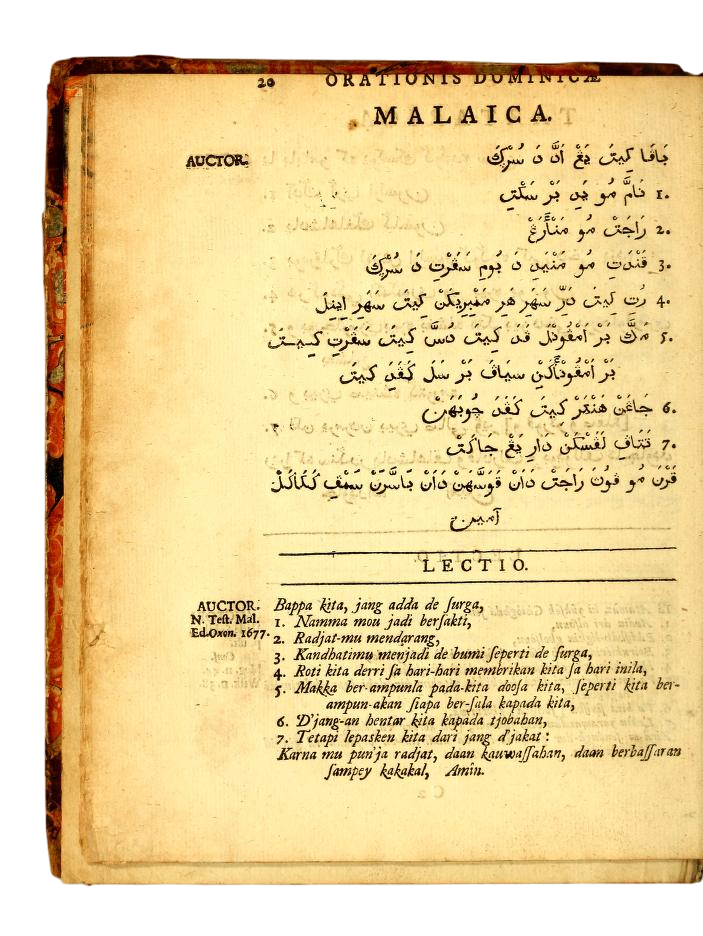
In 1680, Andreas Müller (b. 1630, d. 1694) published a small book containing a collection of the Lord's Prayers in 83 languages. The work was later revised and expanded by other authors in 1700, 1705, and 1713. The following discussion examines the Malay and Chinese texts as presented in the revised edition published in 1713. The Lords Prayer in above a hundred languages, versions, and characters, published in 1713. Oratio Dominica ΠΟΛΥΓΛΩΤΤΟΣ ΠΟΛΥΜΟΡΦΟΣ. Nimirum Plus Centum Linguis, Versionibus, aut Characteribus Reddita & Expressa. Editio Novissima. Speciminibus variis quam priores comitatior. The work is built upon the earlier publication of Müller although the title page of the book did not explicitly mention any editor or author. In the Malay text, the Lord's kingdom 國 was rendered as ra'jat, using an old spelling system devised by Van Ophuijsen. It is...
. . . I pointed out how the Bandar, in refusing to accept terms and in fighting against his Sovereign, was a rebel, and that all who assisted him were rebels. That, as he knew well, two out of his three captains, China, had sided with the Bandar, and had given him (the Bandar) more than moral support in his recent operations. (I here showed him the Chinese document attached, which is an order of the head of the Macaos, Wong Hin, to any of his people to render prompt assistance at any time and in any way to the Bandar) . . . . after some more conversation we parted, but shortly afterward he brought to our quarters the two captains, China, I had been advising him about, Wong Hin and Ugoli Kim, and said that, as the Governor had sent me to assist him, he had made up his mind to put the management of everything into my hands . . . C. B. Plunket, Inspector-General of Police of the Straits Settlements November 30, 1874 Pa...




Comments