Posts

Showing posts with the label Sexagenary birthdate

On the Periodicity of Chinese Sexagenary Indices

I have written a short note on the periodicity of Chinese sexagenary indices or bazi 八字, $$\mathbf{I} = (I_{\rm year}, I_{\rm month}, I_{\rm day}, I_{\rm hour})$$ after reading a book by Hee, an accountant by training, on the same subject, many years ago. I was motivated primarily by a section of her book. On page 22, Hee wrote: . . . because of the numerous possible combinations, it takes 60 years for the same set of year pillars to repeat itself (by comparison, a set of month pillars repeats itself after just five years). Therefore, if you have a certain day and time, the set of four pillars will repeat itself in 60 years. However, since the same day may not appear in exactly the same month - and even if it is in the same month, the day may not be found in the same half month - it takes 240 years before the identical four pillars appear again. . . Basically, the claims are as follows: When considered independently, the periodicity of the year-index, \(I_{\rm year}\),...

Modulo 60 and Shang Chinese

Image
To understand how calendrical matters were handled by the Shang 商 Chinese. It is important to learn to count numbers in modulo 60 . The reason for their preference of modulo 60 is not exactly known, probably the ancestors of the Shang Chinese shared a similar set of extrasomatic knowledge with the ancestors of the Babylonians when they were still in North Africa . The current norm of handling the grouping of days is to use modulo 7: \(L\) Day count Name of the day 1 Day 1 Monday 2 Day 2 Tuesday 3 Day 3 Wednesday 4 Day 4 Thursday 5 Day 5 Friday 6 Day 6 Saturday 7 Day 7 Sunday The ancient Chinese, however, used several different styles to count their day ...

Wuxing and Compatibility Coefficient: Part IV

Image
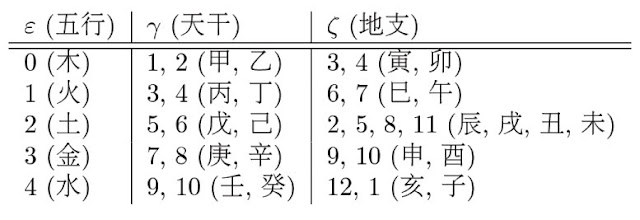
In Chinese fate calculation, there exists a mapping between the wuxing (五行) and sexagenary components (celestial stem, γ = tiangan 天干 and terrestrial branches, ζ = dizhi 地支). When the birthdate of a person is stated in sexagesimal form, one is able to deduce the xing associated with the eight sexagenary components or bazi (八字). Normally this mapping is in table form: A useful set of numerical formulas to handle the mapping is to use The basic principle to compute the mutual compatibility of two sets of sexagenary birth data is to pair the corresponding sexagenary components of the two individuals and compute their compatibility coefficients. We can then construct a normalized rank based on the eight compatibility coefficients computed, and "foretell" whether the two individuals can live in harmony.

On the Birthdate of the Little Nyonya

Image
Little Nyonya (小娘惹) is one of the very fine Chinese language drama produced by MediaCorp Singapore in the past few decades. Its average audience measurement of about 1 million over the one month it was broadcast is a direct evidence of the quality and popularity of the drama. Because it was suppose to be a serious drama, some people are taking this drama very seriously. One of the "loophole" mentioned in Wikipedia concerns Yamamoto Yueniang (山本月娘)'s birthdate. It is claimed that: "Yueniang's age was also subjected to some inconsistencies. When Juxiang sought an old man's help in writing her daughter's time of birth, the man wrote "甲子年八月十五出生” which indicates a date in 1924. Yueniang was said to be 70 years old in present day, but she would be 84 years old if she was born in 1924.[5] Too, she stated that 1942 is the time where the Japanese occupied Singapore and she was eight (meaning she was born in 1934)." This claim, however, as pointe...

Wuxing and Compatibility Coefficient: Part III

Image
If the xing were to be arranged in a clockwise manner according to Dong's numerical order, we have the following pentagon of wuxing . Interestingly, pentagon is the only polygon for which number of constructive relationship (number of sides) equals the number of destructive relationship (number of diagonals). This is easily proven since the only solution to the following equation: is n = 5. Now, it is useful for a computer programmer to introduce a coefficient which can be used to compute the compatibility of any two given xing without having to refer to Dong's pentagon. The three numerical values of compatibility coefficient c p (namely -1, 0, 1) are to be interpreted as destructive, neutral, and constructive, respectively. A convenient way to compute c p is to use the following equation: For example, in the case of wood xing and fire xing , we have c p (0,1) = 1, a constructive relationship. In the case of fire xing and water xing , we have c p (1,4) = -1, ...

Wuxing and Compatibility Coefficient: Part II

Image
The first person in China to explain wuxing (五行) in term of the principle of mutual construction was probably Dong Zhongshu (董仲舒), a Western Han philosopher (around 135 BC). In Chunqiu Fanlu, Fasicle 11, Chapter 42, (春秋繁露, 卷第十一, 五行之义第四十二), he wrote There are five xing in the heaven: the first is Jupiter (wood), the second is Mars (fire), the third is Saturn (earth), the fourth is Venus (metal), and the fifth is Mercury (water). Jupiter (wood) is the first of the five xing , Mercury (water) is the last, and Saturn (earth) is in the middle, this is the heavenly order. Wood begets fire, fire begets earth, earth begets metal, metal begets water, and water begets wood, just like the father-and-son relationship. (天有五行:一曰木,二曰火,三曰土,四曰金,五曰水。木,五行之始也,水,五行之终也,土,五行之中也,此其天次之序也。木生火,火生土,土生金,金生水,水生木,此其父子也。) The fact that wood is assigned the first place in that order is probably because of autotrophic nature of the plants (and hence wood). Following Dong's numerical order, we may assign a numb...

Wuxing and Compatibility Coefficient: Part I

Wuxing (五行) is a very fundamental concept in Chinese fate calculation. Some scholars believe that wuxing originates from the planetary motion of the five planets visible to the naked eyes, namely Mercury, Venus, Mars, Jupiter, and Saturn. In the Chinese literature, the term wuxing first appeared in a war declaration when Qi (启), the second King of the Xia Dynasty, was preparing to launch a war on the tribe of You Hu (有扈). Shang Shu: Gan Shi (The Declaration of Gan)《尚书·甘誓》: The tribe of You Hu insulted the wuxing and muddled the correct calendrical order. It is the heaven will that they must be destroyed. I am now to dutifully carry out my heavenly duty to punish them. (有扈氏威侮 五行 ,怠弃三正,天用剿绝其命,今予惟恭行天之罚。) In this text, the term wuxing was not defined. It is possible that the author of the declaration meant to use the term wuxing in its planetary sense or `heaven' in general. The first discussion of Wuxing can be found in Hong Fan (洪范). When Ji Fa (姬发) destroyed the Shang Dyn...