Posts

From Gauss's mean error to Yule's standard error

Image
To fully appreciate the math we are about to discuss, we must first rewind our clock to 1911. Udny Yule was enrolled into University College London at the young age of 16, where he remained from 1887 to 1890. Among his teachers were Karl Pearson (then Professor of Applied Mathematics), Alexander Kennedy (Professor of Engineering), J. A. Fleming (Professor of Electrical Engineering), J. M. Hill (Professor of Mathematics), C. Foster (Professor of Physics). While Yule was working with Heinrich Hertz in Bonn, Pearson offered him a role as demonstrator at UCL which he accepted, and he occupied this position from 1893 to 1896 (the year he was promoted to Assistant Professor of Applied Mathematics). 1911 is an important year for students of statistics. For one, the world's first statistics department was founded by Karl Pearson (1857 – 1936) in UCL. And two, the world's first statistics textbook was published by Udny Yule (1871 – ...

Modeling of sample mean by a process engineer a Victorian beer factory

Image
The following example is taken from Dalgaard (2008, p. 97), who, in turn, got his data from Altman (1991, p. 183). In 1986, Manocha and his colleagues studied eleven healthy female subjects (aged 22 to 30) for ten days, and took careful measurements of their daily calorie intakes, \(\varepsilon_{kj}\), where \(j\) is the day index. Here, \(\varepsilon\) is energy intake data. But it can be anything numeric depending on your use case. In the table, we see that Manocha condensed 110 data points (\(\varepsilon_{kj}\)) into 11 data points (\(\varepsilon_k\)). See Peter Dalgaard (2008) Introductory statistics with R 2nd edition, Springer Science + Business Media, LLC, New York. And also Douglas G. Altman (1991) Practical statistics for medical research , Chapman & Hall/CRC, Boca Raton. S. Manocha, G. Choudhuri, B. N Tandon (1986) A study of dietary intake in pre- and ...

First demo of the method of moment by Pearson in 1893

In 1887, John Venn published a letter John Venn (1887) The law of error, Nature 36(931), pp. 411 - 412 (September 1, 1887) in Nature criticising Adolphe Quetelet (1796 - 1874) for naively believing that normal distribution is the only viable probability density function in nature. Venn's opening paragraph is reproduced as follows: Everyone interested in the theory of statistics is aware how strongly Quetelet was under the conviction that there is only one law of error prevalent for the departure from the mean of a number of magnitudes or measurements of any natural phenomonon. I have done what I can to protest against this doctrine as a theoretic assumption; and recently Galton and Edgeworth have shown how untenable it is, and how great is the importance of studying the properties of other laws of error than the symmetrical binomial, and its limiting form the exponential. Karl Pearson supported the notions of Venn and Galton an...

Nakajima's 1982 formulation of OEE

A composite metric named overall equipment effectiveness (OEE, 設 備 総 合 効 率 ) was first proposed by Seiichi Nakajima ( 中 嶋 清 一 ) in early seventies. In his 1982 book (Deploying TPM At at the time when the book was written, the M in TPM means maintenance and not management. Program for Reforming Manufacturing, 生 産 革 新 のためのTPM 展 開 プログラム), the following formulation was given: \begin{align} {\small 設備総合効率} &= {\small 時間稼働率} \times {\small 性能稼働率} \times {\small 良品率}\\ \eta_{\rm oee} &= \eta_{\rm time} \times \eta_{\rm rate} \times \eta_{\rm quality} \end{align} The first ratio, 時 間 稼 is a kanji formed from the semioglyph 禾 (meaning rice or other cash crops) and the audioglyph 家, while 働 is a kanji formed from the two semioglyphs: 人/亻 (people) and 動 (move). Together, 稼働 can be taken to mean people working in the paddy field. When the context is changed from human to machine, the word 稼働 means that the equipment is in running or operating mode. 稼 働 率 , \beg...

Peerage in Ming Dynasty and its use in Melaka

Image
When Zhu Yuanzhang 朱元璋 founded the Ming Dynasty in 1368, his eldest son Zhu Biao 朱標 (10 October 1355 – 17 May 1392) was made the crown prince 太子 and heir-apparent to the Ming throne. 皇帝 Prince of the Zeroth Rank The Throne of Ming Dynasty Governor of the Ming Kingdom 太子 Dotted line denotes eldest son 親王 Prince of the First Rank (10,000 shi) Non-firstborn son of the Emperor Governor of a given Province or Princedom 世子 郡王 Prince of the Second Rank (2,000 shi) Non-firstborn son of the Prince of First Rank Governor of a given Subprovince or Subprincedom His other twenty+ sons were titled Prince of the First Rank 親王 and were each given a province (or princedom) to govern, for examples, Zhu Shuang 朱樉 (3 December 1356 – 9 April 1395) Prince of Qin 秦王 (enfoeffed in Xian 西安) Zhu Gang 朱棡 (18 December 1358 – 30 March 1398) Prince of Jin 晉王 (enfoeffed in Jinyang 晉陽) Zhu Di 朱棣 (2 M...

Bilabial plosive consonants in Indian, Chinese and Malay languages

Image
There are four labial plosive sounds which we can make: /p, pʰ/ is unvoiced when vocal cord is not vibrated pair and /b, bʱ/ is the voiced when vocal cord is vibrated pair. Our northern Indian friends use all four of them in their speech: प (pa) /pa/ , फ (pha) /pʰa/ , ब (ba) /ba/ , भ (bha) /bʱa/ while the northern Chinese is only able to articulate the unvoiced versions. Here's a summary of the two labial plosive consonant in Beijing 北京 dialect: 巴 (bā) /pá/ , 趴 (pā) /pʰá/ , ◯ /b/ , ◯ /bʱ/ These two unvoiced labial consonants are so important that they are fossilized in the bp mf ㄅㄆㄇㄈ acronym (m and f represent the nasal and fricative consonants in the labial series). These standard Mandarin Mandarin or 官話 is official language used in Chinese court, the first recorded use of the word Mandarin can be found in Robert Parke's translation (1589) of Mendoza's History of China: The Mandelines of the sea, which be certai...

Pgr makan padi: Unfencing the bird theory

Image
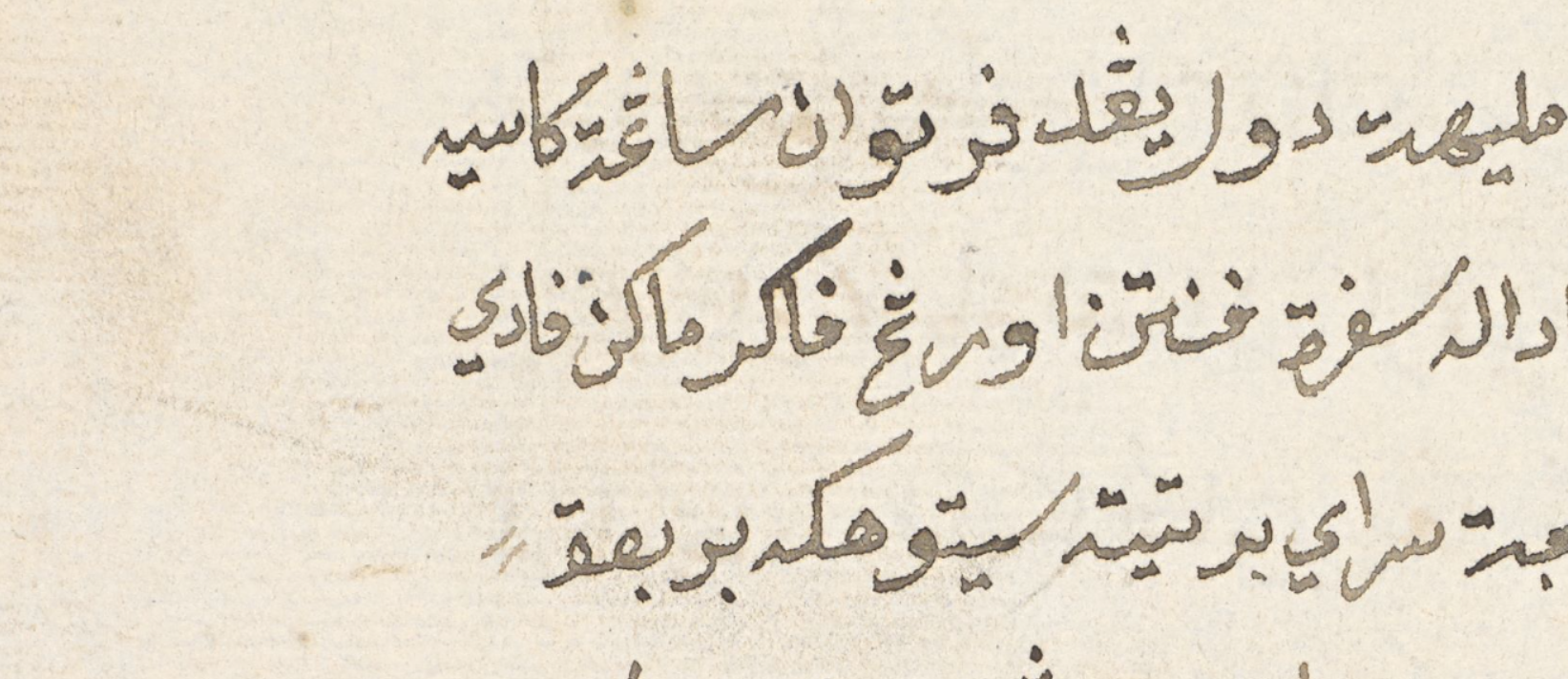
The opening paragraph of Harry Frankfurt's little book is as follows: One of the most salient features of our culture is that there is so much bullshit. Everyone knows this. Each of us contributes his share. But we tend to take the situation for granted. . . Frankfurt's view is that the production of bullshit is inevitable in our modern digital landscape since it is stimulated whenever a person's opportunities to speak about some topic exceed his knowledge of the facts that are relevant to that topic (p. 61). The phrase pagar makan padi (ڤاڬر ماكن ڤادي) in an old Hikayat Hang Tuah manuscript (dated between 1828 to 1835), British Library Or. 16215. See the last phrase on the seventh row of folio f. 61r. The proverb is used by Patih Kerma Wijaya to refer to Hang Tuah when he was talking to the Sultan of Melaka, in which Hang Tuah (the pagar ) was accused of having multiple affairs with the concubines (the padi ) in the palace. One such bullshit is man...

“Pagar makan padi" in early publications and manuscripts

Image
The Malay phrase pāgar mākan pādi or ڤاڬر ماكن ڤادي can be found in R. J. Wilkinson's Malay-English Dictionary . On p. 449, Wilkinson wrote: ڤاڬر pagar. A fence; a palissade; a row of stakes or palings. Pagar makan padi : the fence eats up the padi ; the precautions for diminishing loss eat up the profit. . . Even though the example given (in a business context) is rather odd (since the phrase pāgar mākan pādi is normally used when trust is betrayed See Abdullah Hassan's Kamus Istimewa Peribahasa Melayu (2nd ed.) for example. Entry 2930: Padi makan padi (= tanaman). Orang yang kita percayai berkhianat kepada kita, in , p. 160. Cross-references are made to Entries 2939, 3735, 3996, and 4217, which are (a) Pancing makan umpan (p. 160); (b) Sokong membawa rebah (p. 201); (c) Telunjuk mencocok (= merosok, menikam) mata (p. 214); (d) Tongkat membawa rebah (p. 225). ), The English title of the book by Ozay Mehmet is Development in Malaysia: Poverty, wealth...